
Most bitcoin poker sites now accept USDT alongside BTC. That raises an obvious question: if the poker site denominates your balance in dollars anyway, is there any reason to deposit bitcoin instead of a stablecoin? The honest answer: usually USDT, sometimes BTC — and the right choice for you comes down to fees, volatility, and how you plan to cash out.
TL;DR: the quick answer
Deposit USDT if:
- You are funding from an exchange.
- You want your bankroll denominated in dollars.
- Network fees matter to you.
- You plan to cash out within days.
Deposit BTC if:
- You already hold BTC as your primary savings.
- You want exposure to BTC upside while you play.
- You are funding from a personal wallet that holds BTC long-term.
Never deposit BTC if you will immediately convert to site balance and cash out to a stablecoin anyway — you will eat two conversion spreads for nothing.
Fees: USDT usually wins
Bitcoin network fees fluctuate with mempool congestion, and they can move a lot. During bull markets, a single BTC transaction can cost $5 to $30. For a poker deposit and a later withdrawal, that is $10 to $60 in fees round-trip — money that comes straight out of your bankroll before the cards are in the air.
USDT behaves very differently, because you can choose the network it travels on. USDT on TRON (TRC-20) costs about $1 per transaction regardless of congestion. USDT on Ethereum is more expensive, but still usually under BTC fees during mempool spikes. On Solana or Polygon, USDT fees are essentially zero.
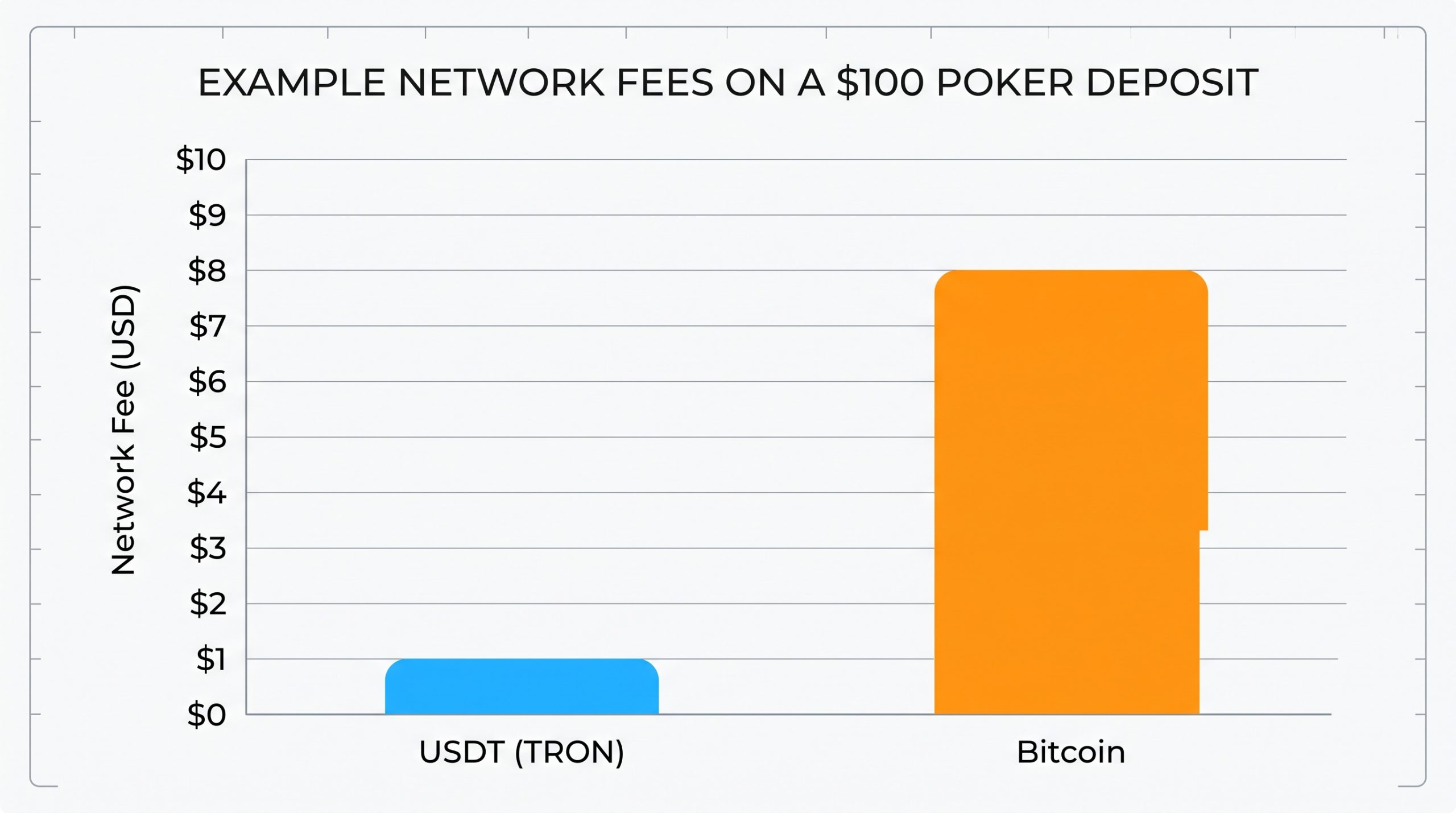
Put that in session terms. For a $100 deposit, the difference between $1 in USDT fees and $8 in BTC fees is 7% of your session value before you see your first hand. That is a real edge you are giving away, and unlike variance at the table, it is a cost you control completely.
Even operators that lead with bitcoin acknowledge this size threshold. ACR Poker’s guide to choosing a coin says bitcoin is the right choice when the deposit is large enough that network fees represent a small percentage of the transfer amount. Read that in reverse and it points to the same conclusion as the numbers above: for smaller deposits, the cheap stablecoin rails win.
Volatility: USDT is a feature, not a bug
The hidden cost of depositing BTC to a poker site is a denomination mismatch. Your balance at the tables is denominated in dollars (or site chips), but your withdrawal is denominated in BTC. If bitcoin drops 10% while you are playing, your $500 bankroll cashes out as 10% less BTC than you deposited — even if you broke exactly even at the table. You played break-even poker and still lost, just not at the felt.
The flip side is real too. If bitcoin rises 10% during your session, you cash out with 10% more BTC than you sent in. Some players genuinely like this — it works like a free call option on BTC upside while you play. If BTC is your long-term holding anyway, keeping your bankroll in it means your poker money moves with the rest of your stack.
USDT removes the volatility entirely. Your session profit or loss is whatever you won or lost at the table, period. This is exactly what the stablecoin is built for: CoinPoker’s Tether page notes that USDT is designed to maintain a stable value, making it less exposed to cryptocurrency price volatility than assets such as Bitcoin or Ethereum. DappRadar’s overview of crypto poker draws the same line: Bitcoin and Ethereum are the most widely supported coins, while stablecoins like USDT keep your bankroll price-stable during play, and it highlights fast, low-fee chains such as Solana.
The practical question to ask yourself: are you here to play poker, or to play poker while also making a side bet on bitcoin’s price? Either is legitimate. Just make the choice deliberately rather than by default.
Anonymity: neither coin is as private as you think
Bitcoin is pseudonymous, not anonymous. If you deposit BTC from an exchange withdrawal, the exchange knows the withdrawal, the destination address, and can provide that information to regulators on request.
USDT is even less private. The issuer, Tether, can freeze individual addresses — and does, with a public blocklist. Stablecoin deposits from centralized exchanges leave the same audit trail as BTC deposits, plus that issuer-level freeze risk on top.
If privacy is your priority, the answer is not “BTC or USDT.” It is: move funds through your own wallet for at least one hop before depositing, and consider a Monero-to-BTC conversion for maximum unlinkability. Neither coin gives you privacy by itself; your handling of the funds does.
Speed: USDT wins, usually
USDT on TRON or Polygon credits at the poker site in under a minute. Bitcoin takes 10–30 minutes for 1–2 confirmations. Most of the time that gap does not matter, because you fund your account before you sit down. But for the edge case where you need to top up a stack mid-tournament, USDT is the only realistic option.
There is an exception worth knowing: many poker sites credit BTC as “unconfirmed balance” immediately for cash game play, even before the first confirmation. Where that applies, BTC is effectively instant too. Check how your site handles it before you rely on it.
Withdrawal symmetry matters
You generally cash out in the same asset you deposited with: deposit BTC, withdraw BTC; deposit USDT, withdraw USDT. If you deposit BTC and want to cash out as USDT, most sites will charge a conversion spread of 1–3% on top of network fees.
So plan the round trip before the first deposit. If your bankroll lives in USDT on an exchange, deposit USDT and let it come back the same way. If it lives in BTC in your cold storage, deposit BTC and withdraw BTC. The worst outcome is paying conversion costs in both directions because you never decided where the money should end up.
What other crypto poker guides recommend
The wider industry does not settle this debate either, which is itself useful information. CardPlayer’s bitcoin poker guide calls bitcoin the best option, with alternatives such as Ethereum and USDT mentioned alongside it. Meanwhile, Primedope’s comparison of seven crypto poker rooms — covering coins accepted, withdrawal times, and rake — notes that CoinPoker holds every balance in USDT.
The takeaway: there is no single industry answer, so the deciding factors come back to the ones above — how large your deposit is relative to network fees, and whether you want price exposure while you play.
What we actually do
For review deposits at this site, we split our approach by amount:
- Under $250: USDT on TRON. Fees are trivial, speed is best, and we do not want session volatility.
- $250 to $2,000: BTC. Fees become negligible as a percentage, and the volatility cuts both ways over longer sessions.
- Over $2,000: BTC, almost always. At that size, you likely hold BTC as your main crypto and do not want to buy USDT just for a poker session.
Pick a wallet that matches your coin
Whichever coin you choose, make sure your wallet actually supports it. Electrum is BTC-only. Exodus and Trust Wallet hold both BTC and USDT, which keeps things simple if you expect to switch between the coins depending on session size.
The bottom line
Deposit USDT when the money is coming from an exchange, the deposit is small, or you want your results measured purely in dollars. Deposit BTC when bitcoin is already your primary holding and you are comfortable with — or actively want — price exposure during the session. And never route through BTC just to convert it away at both ends: that is two conversion spreads for nothing.